

Mass Of An Ink Pen

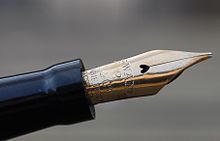
Close-upward of traditional fountain pen with an iridium-tipped stainless steel nib


Various gimmicky and vintage fountain pens (left to correct):
- Pilot Justus 95
- Pelikan Souverän M1000
- Montblanc Meisterstück 149
- Pilot Heritage 912
- Parker Duofold Centennial
- Sheaffer Snorkel Admiral
- Lamy Dialog iii
- Welty
- Parker Sonnet
- Conway Stewart 55
- Waterman Thorobred
- Mabie Todd Swan 3220
A fountain pen is a writing instrument which uses a metallic nib to use a h2o-based ink to paper. It is distinguished from earlier dip pens past using an internal reservoir to hold ink, eliminating the need to repeatedly dip the pen in an inkwell during use. The pen draws ink from the reservoir through a feed to the nib and deposits the ink on paper via a combination of gravity and capillary action. Filling the reservoir with ink may exist achieved manually, via the use of an eyedropper or syringe, or via an internal filling mechanism which creates suction (for example, through a piston mechanism) or a vacuum to transfer ink directly through the nib into the reservoir. Some pens employ removable reservoirs in the course of pre-filled ink cartridges.[1]
History [edit]
Early prototypes of reservoir pens [edit]
According to Qadi al-Nu'man al-Tamimi (d. 974) in his Kitab al-Majalis wa 'l-musayarat, the Fatimid caliph Al-Mu'izz li-Din Allah in Arab Egypt demanded a pen that would not stain his hands or clothes, and was provided with a pen that held ink in a reservoir, assuasive it to be held upside-down without leaking.[2]
There is compelling evidence that a working fountain pen was synthetic and used during the Renaissance by artist and inventor Leonardo da Vinci. Leonardo's journals contain drawings with cross-sections of what appears to be a reservoir pen that works by both gravity and capillary action. Historians as well took annotation of the fact that the handwriting in the inventor's surviving journals is of a consistent dissimilarity throughout, rather than exhibiting the characteristic fading blueprint typical of a quill pen caused by expending and re-dipping. While no physical item survives, several working models were reconstructed in 2011 by creative person Amerigo Bombara that accept since been put on brandish in museums dedicated to Leonardo.[three]

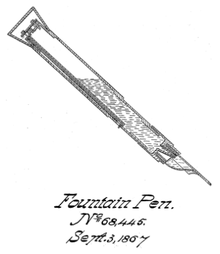
K. Klein and Henry W. Wynne received U.S. Patent 68,445 in 1867 for an ink chamber and delivery system in the handle of the fountain pen
European reservoir models [edit]

Deliciae physico-mathematicae, 1636
The fountain pen was available in Europe in the 17th century and is shown by contemporary references. In Deliciae Physico-Mathematicae (a 1636 mag), German inventor Daniel Schwenter described a pen made from ii quills. One quill served as a reservoir for ink inside the other quill. The ink was sealed inside the quill with cork. Ink was squeezed through a small hole to the writing point.[4] In 1663 Samuel Pepys referred to a metallic pen "to carry ink".[5] Noted Maryland historian Hester Dorsey Richardson (1862–1933) documented a reference to "three silver fountain pens, worth 15 shillings" in England during the reign of Charles 2, c. 1649–1685.[half-dozen] Past the early 18th century such pens were already unremarkably known equally "fountain pens".[7] Hester Dorsey Richardson as well constitute a 1734 note fabricated by Robert Morris the elderberry in the ledger of the expenses of Robert Morris the younger, who was at the time in Philadelphia, for "i fountain pen".[six] Perchance the best-known reference, however, is that of Nicholas Bion (1652–1733), whose illustrated clarification of a "plume sans fin" was published in 1709 in his treatise published in English language in 1723 as "The Construction and Principal Uses of Mathematical Instruments". The earliest datable pen of the class described by Bion is inscribed 1702, while other examples bear French hallmarks equally tardily as the early on 19th century.
Commencement patents [edit]
Progress in developing a reliable pen was deadening until the mid-19th century because of an imperfect understanding of the function that air pressure plays in the performance of pens. Furthermore, almost inks were highly corrosive and total of sedimentary inclusions. The first English patent for a fountain pen was issued in May 1809 to Frederick Fölsch, with a patent covering (amongst other things) an improved fountain pen feed issued to Joseph Bramah in September 1809.[ citation needed ] John Scheffer's patent of 1819 was the commencement design to encounter commercial success, with a number of surviving examples of his "Penographic" known. Another noteworthy pioneer design was John Jacob Parker's, patented in 1832 – a self-filler with a screw-operated piston.[8] The Romanian inventor Petrache Poenaru received a French patent on May 25, 1827, for the invention of a fountain pen with a butt made from a big swan quill.[9]
Mass-manufactured nibs [edit]
In 1828, Josiah Mason improved a inexpensive and efficient slip-in nib in Birmingham, England, which could be added to a fountain pen and in 1830, with the invention of a new machine, William Joseph Gillott, William Mitchell, and James Stephen Perry devised a style to mass manufacture robust, cheap steel pen nibs (Perry & Co.).[10] This boosted the Birmingham pen merchandise and by the 1850s, more than half the steel-beak pens manufactured in the earth were made in Birmingham. Thousands of skilled craftsmen were employed in the industry.[11] Many new manufacturing techniques were perfected, enabling the city'southward factories to mass-produce their pens cheaply and efficiently. These were sold worldwide to many who previously could non afford to write, thus encouraging the evolution of education and literacy.[12]
New patents and inventions [edit]
In 1848, American inventor Azel Storrs Lyman patented a pen with "a combined holder and nib".[13] From the 1850s, there was a steadily accelerating stream of fountain pen patents and pens in production. Notwithstanding, it was merely afterwards iii primal inventions were in place that the fountain pen became a widely popular writing musical instrument. Those were the iridium-tipped gold nib, hard safe, and free-flowing ink.[nine]

Waterman 42 Prophylactic Pen, with variation in materials (both red and blackness hard vulcanized rubbers or ebonite) and retracting nibs
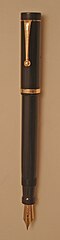
The first fountain pens making use of all these key ingredients appeared in the 1850s. In the 1870s Duncan MacKinnon, a Canadian living in New York City, and Alonzo T. Cross of Providence, Rhode Island, created stylographic pens with a hollow, tubular neb and a wire interim equally a valve.[14] [15] Stylographic pens are now used mostly for drafting and technical drawing but were very pop in the decade beginning in 1875. In the 1880s the era of the mass-produced fountain pen finally began. The dominant American producers in this pioneer era were Waterman, of New York City, and Wirt, based in Bloomsburg, Pennsylvania. Waterman presently outstripped Wirt, along with many companies that sprang up to fill up the new and growing fountain pen market. Waterman remained the market leader until the early 1920s.[xvi]
At this time, fountain pens were nigh all filled by unscrewing a portion of the hollow barrel or holder and inserting the ink by ways of an eyedropper – a slow and messy procedure. Pens also tended to leak inside their caps and at the joint where the barrel opened for filling.[17] Now that the materials' problems had been overcome and the flow of ink while writing had been regulated, the next problems to be solved were the creation of a uncomplicated, user-friendly self-filler and the problem of leakage. In 1890, West. B. Purvis patented a self-filler. Self-fillers began to arrive around the turn of the century; the most successful of these was probably the Conklin crescent-filler, followed past A. A. Waterman'southward twist-filler.[18] [19] The tipping point, however, was the delinquent success of Walter A. Sheaffer's lever-filler, introduced in 1912,[20] paralleled by Parker'southward roughly contemporary button-filler.
Pen leakage [edit]
Meanwhile, many inventors turned their attention to the problem of leakage.[21] Some of the earliest solutions to this problem came in the form of a "rubber" pen with a retractable indicate that immune the ink reservoir to be corked like a bottle. The almost successful of these came from Francis C. Chocolate-brown of the Caw's Pen and Ink Co. and from Morris Due west. Moore of Boston.[22]
In 1898, George Safford Parker released the Parker Jointless, named then because its barrel was unmarried-piece to foreclose leakage. The department associates fit into the pen's terminate like a cork stopper; whatever leaked ink was kept within the nib.[23]

"Waterman'south ideal fountain pen" 1908 advertizement
In 1908, Waterman began marketing a popular condom pen of its ain.[24] For pens with non-retractable nibs, the adoption of screw-on caps with inner caps that sealed around the beak by begetting against the front of the section finer solved the leakage problem (such pens were also marketed as "safety pens", as with the Parker Jack Knife Safety and the Swan Rubber Spiral-Cap).[25] [26]
Farther innovation [edit]

Lever filler pen made of celluloid by Mabie Todd & Co. New York (1927)
In Europe, the German supplies visitor which came to be known as Pelikan was started in 1838, and they first introduced their pen in 1929.[27] This was based upon the conquering of patents for solid-ink fountain pens from the manufactory of Slavoljub Penkala from Croatia (patented 1907, in mass production since 1911), and the patent of the Hungarian Theodor Kovacs for the modern piston filler by 1925.[28]
The decades that followed saw many technological innovations in the industry of fountain pens. Celluloid gradually replaced hard prophylactic, which enabled product in a much wider range of colors and designs.[29] At the same time, manufacturers experimented with new filling systems. The inter-war period saw the introduction of some of the about notable models, such as the Parker Duofold[thirty] and Vacumatic,[31] Sheaffer's Lifetime Balance series,[32] and the Pelikan 100.[33]
During the 1940s and 1950s, fountain pens retained their authorisation: early ballpoint pens were expensive, were prone to leaks and had irregular inkflow, while the fountain pen connected to benefit from the combination of mass production and craftsmanship. (Bíró's patent, and other early on patents on ball-betoken pens often used the term "ball-point fountain pen," because at the time the ball-bespeak pen was considered a blazon of fountain pen; that is, a pen that held ink in an enclosed reservoir.)[34] This catamenia saw the launch of innovative models such equally the Parker 51, the Aurora 88, the Sheaffer Snorkel, and the Eversharp Skyline and (later on) Skyliner, while the Esterbrook J series of lever-fill models with interchangeable steel nibs offered inexpensive reliability to the masses.[35] [36]
Popular usage [edit]

Lamy 2000 piston filler made of polycarbonate and stainless steel, launched in 1966 and still in production
Past the 1960s, refinements in ballpoint pen production gradually ensured its dominance over the fountain pen for casual use.[37] Although cartridge-filler fountain pens are still in common use in France, Italy, Germany, Republic of austria, Republic of india, and the Great britain, and are widely used past young students in most private schools in England, at least one individual schoolhouse in Scotland,[38] and public simple schools in Germany,[39] a few modern manufacturers (especially Montblanc, Graf von Faber-Castell, and Visconti) now depict the fountain pen as a collectible item or a condition symbol, rather than an everyday writing tool.[40] All the same, fountain pens continue to accept a growing post-obit among many who view them as superior writing instruments due to their relative smoothness and versatility. Retailers continue to sell fountain pens and inks for coincidental and calligraphic use. Recently, fountain pens have made a resurgence, with many manufacturers of fountain pens saying sales are climbing. This has led to a new wave of coincidental employ fountain pens and custom ink manufacturers, who utilize online stores to easily sell fountain pens to a wider audience.[41]
Feed [edit]
The feed of a fountain pen is the component that connects the nib of the pen with its ink reservoir.[42]
It not but allows the ink to flow to the nib (in what is often described equally a "controlled leak") just also regulates the amount of air flowing backwards up to the reservoir to replace this lost ink.[43]
Information technology does this through the use of a series of narrow channels or "fissures" that run downwardly its lower edge. As ink flows down these fissures, air is simultaneously immune to menses upwardly into the reservoir in an even commutation of volumes. The feed allows ink to flow when the pen is being put to paper but ensures ink does non flow when the pen is not in utilize. The feed makes use of capillary action; this is noticeable when a pen is refilled with a brightly coloured ink. The ink is taken up and into the feed by way of capillary action (and is often visible in clear demonstrator pens), but is not dispensed onto the paper until the pecker makes contact.[42]
How the feed is shaped may determine the wetness and flow of a particular pen. For this reason, feed material lone and its surface roughness may take a pregnant issue on the manner two pens of the same beak size write.[44] [45]
Pen feeds are crucial to preventing ink from dripping or leaking. Feeds often feature finned structures intended for buffering fountain pen ink. Buffering is the chapters to catch and temporarily hold an overflow of ink, caused past conditions other than writing. When a fountain pen beak receives such an overflow it will result in ink blobbing or dripping as well known as burping. A pen with a misconfigured feed might fail to deposit any ink whatsoever.[46]
Fiber feeds [edit]
Some fountains pens utilize a cobweb wick underneath the beak. They often have a plastic function that looks like a feed that is simply used to hold the fiber wick in identify and does not help with ink flow. The machinery of action is like a felt pen, just with a fountain pen neb on top of it. The fiber feeds offering plenty of ink flow and can stay wet for extended periods. Cleaning fiber feed pens can require longer soaking in h2o.
Nibs [edit]
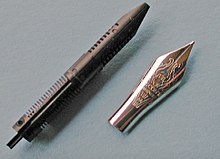
Particular of a Visconti stainless steel nib and feed with a finned ink buffering structure at its rear half

Tip of a fountain pen neb
According to Mathur et al., "the modernistic fountain pen nib may be traced back to the original gold beak which had a tiny fragment of ruby fastened to class the wear-point."[47] Following the discovery of the platinum group of metals which include ruthenium, osmium, and iridium, "a small quantity of iridium was isolated and used on the iridium-tipped gold dip pen nibs of the 1830s."[47] Today, nibs are usually made of stainless steel or gilt alloys, with the most popular golden content being 14 carat (58⅓%) and 18 carat (75%).[48] Titanium is a less common metal used for making nibs. Gilt is considered the optimum metal for its flexibility and its resistance to corrosion, although gold'southward corrosion resistance is less of an issue than in the past because of meliorate stainless steel alloys and less corrosive inks.[48] Visconti used to use nibs made out of palladium, as information technology acts like gold, merely take now changed to using gilt for most of their nibs as it is easier to source.
Nib plating [edit]
Farther gold plating provides favorable wettability, which is the ability of a solid surface to reduce the surface tension of a liquid in contact with it such that it spreads over the surface.[49]
Nib tipping [edit]
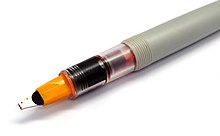
The Pilot Parallel, an case of a type of an italic neb used in fountain pens, oftentimes used to create fine art and calligraphy. This pen has two flat plates that encounter in the centre in identify of a traditional nib.
Gold and about steel and titanium nibs are tipped with a hard, wear-resistant alloy that typically includes metals from the platinum group. These metals share qualities of extreme hardness and corrosion resistance. The tipping cloth is often called "iridium", simply in that location are few, if any, nib or pen manufacturers that used tipping alloys containing iridium metal since the mid-1950s.[l] The metals osmium, rhenium, ruthenium, and tungsten are used instead, generally as an alloy, with a footling chip of osmium, rhenium, ruthenium, and tungsten in a mix of other materials, produced as tiny pellets which are soldered or welded onto a nib tip prior to cutting the nib slit and grinding the tip into its final shape.[51] Untipped steel and titanium points will article of clothing more than rapidly due to abrasion by the paper.[48]
Capillary action [edit]
The beak commonly has a tapering or parallel slit cut down its centre, to convey the ink down the nib by capillary action, too equally a "sabbatical hole" of varying shape.[52] The breather hole has no bodily function regarding controlling the ink or air flow. Its main function is to provide an endpoint to the nib slit and forbid inaccuracies during pecker slit cutting. Adding distance between the breather hole and the nib tip adds elasticity or flexibility to the nib. The sabbatical hole also acts equally a stress relieving indicate, preventing the nib from cracking longitudinally from the cease of the slit every bit a result of repeated flexing during utilize.[42]
The whole nib narrows to a point where the ink is transferred to the paper. Broad calligraphy pens may have several slits in the nib to increment ink flow and assistance distribute it evenly across the broad point. Nibs divided into three 'tines' are ordinarily known equally music nibs. This is considering their line, which can be varied from broad to fine, is suited for writing musical scores.[53]
Types of nibs [edit]
Although the most common nibs end in a circular point of various sizes (extra fine, fine, medium, broad), diverse other nib shapes are available. Examples of this are double broad, music, oblique, reverse oblique, stub, italic, and 360-degree nibs.[52]
Broader nibs are used for less precise emphasis, with the benefit of a greater level of ink shading, a property wherein ink pools in parts of a stroke to cause variations in colour and/or sheen, a property where dyes in ink crystallize on a page instead of absorbing into the paper, which leads to a unlike color being seen due to thin picture interference, on less absorbent paper. Effectively nibs (due east.thou. extra fine and fine) may be used for intricate corrections and alterations, at the expense of shading and sheen. Oblique, reverse oblique, stub, and italic nibs may exist used for calligraphic purposes or for general handwritten compositions. The line width of a item pecker may vary based on its country of origin; Japanese nibs are often thinner in general.[54]
Bill flexibility [edit]
Flexibility is given to nibs in several ways. First, the thickness of the bill metal changes flex. When the nib alloy has been pressed thick it will result in a difficult nib, while thinly pressed nibs are more flexible. Nibs can be pressed and then that they are thinner at the tip and thicker at the feed to mitigate stiffness or to give a more than controlled flex. Second, the curve of the beak determines in part how stiff the nib will be.[55]
Nibs pressed into more than deeply convex curves, or into three or five faceted curves, will be stiffer than flatter nibs. 3rd, the "breather hole" size, shape, and position alter the stiffness. Heart-shaped holes will meliorate flex as they widen, while round, small holes stiffen the pen. Fourth, the length of the tines determines how far they tin spread under pressure, shorter tines make a stiffer bill. 5th, the alloy used can affect stiffness: as mentioned earlier, gold is considered superior for its flex compared to steel. Moreover, purer gilt (18k and 21k) is softer than virtually lower gold concentration (14k) alloys.[48]
Mabie Todd Swan flexible 14k neb
Fountain pens dating from the first half of the 20th century are more than likely to have flexible nibs, suited to the favored handwriting styles of the period (eastward.g. Copperplate script and Spencerian script). By the 1940s, writing preferences had shifted towards stiffer nibs that could withstand the greater pressure required for writing through carbon paper to create indistinguishable documents.[56]
Furthermore, competition between the major pen brands such as Parker and Waterman, and the introduction of lifetime guarantees, meant that flexible nibs could no longer be supported profitably. In countries where this rivalry was not present to the same degree, such every bit the UK and Germany, flexible nibs are more common.[57]
Present, potent nibs are the norm as people exchange betwixt fountain pens and other writing modes. These more than closely emulate the ballpoint pens most mod writers are experienced with. Despite being rigid and business firm, the idea that steel nibs write "horribly" is a misconception.[58] More than flexible nibs tin be easily damaged if excessive pressure is applied to them. Ideally, a fountain pen's nib glides across the newspaper using the ink as a lubricant, and writing requires no force per unit area.
Adept quality nibs that have been used appropriately are long lasting, often lasting longer than the lifetime of the original owner. Many vintage pens with decades-old nibs can even so exist used today.[59]

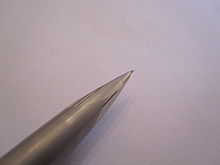
The Integral Nib of a Parker 50 (Falcon)
Different pecker styles [edit]
Other styles of fountain pen nibs include hooded (e.grand. Parker 51, Parker 61,[threescore] 2007 Parker 100,[61] Lamy 2000,[62] and Hero 329),[63] [64] inlaid (e.yard. Sheaffer Targa or Sheaffer P.F.M) or integral Nib (Parker T-1, Falcon, and Pilot Myu 701), which may also be basis to take different writing characteristics.[65]
Users are oft cautioned not to lend or borrow fountain pens equally the nib "wears in" at an angle unique to each private person.[57] A different user is likely to find that a worn-in nib does not write satisfactorily in their hand and, furthermore, creates a 2nd wear surface, ruining the nib for the original user. This, even so, is not a point of business organization in pens with modern, durable tipping textile, as these pens take many years to develop any significant wear.[57]
Filling mechanisms [edit]

Left to Right: Gama Supreme eyedropper, Jinhao 159, and X750 using international standard converters or ink cartridges and Lamy Studio stainless and Nexx M using proprietary Lamy converters or ink cartridges

Eyedropper filler [edit]
The reservoirs of the earliest fountain pens were generally filled by eyedropper. This was a cumbersome and potentially messy process, which led to the commercial development of alternative methods that quickly dominated the industry.[17] However, newer, more convenient filling mechanisms have never entirely displaced "eyedropper-filling" pens in the marketplace, and they remain widely manufactured today. For some the simplicity of the machinery, coupled with the large volume of ink information technology can encapsulate, compensates for the inconvenience of ink transfer.[17]
Afterwards the eyedropper-filler era came the first generation of mass-produced self-fillers, almost all using a condom sac to concord the ink. The sac was compressed and so released by various mechanisms to make full the pen.[66]
Self-filling designs [edit]
The Conklin crescent filler, introduced c. 1901, was one of the starting time mass-produced cocky-filling pen designs. The crescent filling organisation employs an arch-shaped crescent attached to a rigid metal force per unit area bar, with the crescent portion protruding from the pen through a slot and the pressure bar inside the butt. A second component, a C-shaped hard rubber ring, is located between the crescent and the barrel.[67]
Ordinarily, the ring blocks the crescent from pushing downwards. To fill the pen, one but turns the band around the barrel until the crescent matches up to the hole in the ring, allowing one to push down the crescent and squeeze the internal sac.[68]
Several other filling mechanisms were introduced to compete, such equally the coin-filler (where a coin or 'medallion' was supplied along with the pen), lucifer-filler (using a matchstick) and a 'blow-filler' which unsurprisingly required the pen possessor to blow into the barrel to depress the internal sac.[i]
Piston filling innovation [edit]
In 1907, Walter A. Sheaffer patented the Lever filler, using a hinged lever prepare into the pen barrel which pressed down onto a bar which in turn compressed the safe sac inside, creating a vacuum to forcefulness ink into the pen. Introduced in 1912, this innovation was speedily imitated past the other major pen makers. Parker introduced the button filler, which had a button hidden beneath a blind cap on the cease of the butt; when pressed, it acted on a force per unit area bar inside to depress the ink sac.[twenty]
Following the crescent filler came a series of systems of increasing complexity, reaching their apogee in the Sheaffer Snorkel, introduced in 1952. The Sheaffer "Snorkel" organisation filled the ink sac through a retractable tube above and behind the pen point. This eliminated the need to dunk the signal in ink, and the subsequent demand to wipe information technology.[69] With the appearance of the modern plastic ink cartridge in the early 1950s, though, nearly of these systems were phased out in favour of convenience (but reduced chapters).
Spiral-mechanism piston-fillers were fabricated as early on equally the 1820s, just the mechanism's mod popularity begins with the original Pelikan of 1929, based upon a Croatian patent. The basic thought is simple: turn a knob at the terminate of the pen, and a screw mechanism draws a piston upward the barrel, sucking in ink. Thus they were easier to fill, and pens with this mechanism remain very popular today. Some of the before models had to dedicate as much as half of the pen length to the mechanism.[seventy] The advent of telescoping pistons has improved this; the Touchdown Filler was introduced by Sheaffer in 1949. It was advertised as an "Exclusive Pneumatic Downwards-stroke Filler."[71]
To make full it, a knob at the end of the barrel is unscrewed and the fastened plunger is drawn out to its full length. The nib is immersed in ink, the plunger is pushed in, compressing and then releasing the ink sac by ways of air pressure. The nib is kept in the ink for approximately 10 seconds to allow the reservoir to fill. This mechanism is very closely modeled after a like pneumatic filler introduced by Chilton over a decade earlier.[72]
Modern filling mechanisms [edit]

Schmidt K5 piston-style standard international size fountain pen converter, containing a user inserted ii.5 mm diameter Marine grade 316 stainless steel bearing brawl
A capillary filling system was introduced by Parker in the Parker 61 in 1956.[73] In that location were no moving parts: the ink reservoir within the barrel was open at the upper terminate, but contained a tightly rolled length of slotted, flexible plastic. To fill up, the barrel was unscrewed, the exposed open end of the reservoir was placed in ink and the interstices of the plastic sheet and slots initiated capillary action, drawing up and retaining the ink. The outside of the reservoir was coated with Teflon, a repellent chemical compound that released excess ink as it was withdrawn. Ink was transferred through a farther capillary tube to the nib. No method of flushing the device was offered, and considering of bug from clogging with dried and hardened ink, production was eventually stopped.[74]
Around the yr 2000, Pelikan introduced a filling system involving a valve in the blind end of the pen, which mates with a specially designed ink bottle.[75] Thus docked, ink is then squeezed into the pen barrel (which, lacking whatsoever mechanism other than the valve itself, has near the capacity of an eyedropper-fill pen of the same size). This system had been implemented only in their "Level" line, which was discontinued in 2006.[75]
Near pens today use either a piston filler, clasp-bar filler or cartridge.[1] Many pens are as well compatible with a converter, which has the same plumbing equipment as the pen's cartridge and has a filling mechanism and a reservoir attached to it.[1] This enables a pen to make full either from cartridges or from a bottle of ink. The almost common type of converters are piston-style, but many other varieties may exist plant today. Piston-style converters generally accept a transparent round tubular ink reservoir. Fountain pen inks feature differing surface tensions that can crusade an ink to adhere or "stick" against the inside of the reservoir. Mutual solutions for this problem are adding a small-scale (rust-proof) ink agitating object like a 316 or 904L stainless steel or zirconium dioxide bearing brawl, spring or hollow tube in the tubular reservoir to mechanically promote costless motion of the contained ink and ink/air exchange during writing. Adding a very small amount of surfactant such as Triton 10-100 used in Kodak Photo-Flo 200 wetting amanuensis to the ink will chemically promote free movement of the contained ink and ink/air exchange during writing. However, ink might react adversely to adding a surfactant.
Vacuum fillers, such as those used past Pilot in the Custom 823, apply air pressure to fill up the ink chamber. In this instance, while the nib is submerged in ink, a plunger is pushed down the empty sleeping room to create a vacuum in the space behind information technology. The finish of the chamber has a section wider than the rest, and when the plunger passes this point, the departure in air pressure in the surface area backside the plunger and the area ahead of it is suddenly evened out and ink rushes in backside the plunger to fill up the chamber.[76]
Cartridges [edit]
A patent for an ink cartridge system for fountain pens was filed in 1890. In the early 20th century, cartridges were made from glass and sparse copper tubing. Nonetheless, the concept just became successful and pop after the introduction of moulded plastic cartridges, firstly by Waterman in 1953.[77] Modern plastic cartridges can contain small-scale ridges on the inside to promote free movement of the contained ink and ink/air substitution during writing. Oft cartridges are closed with a small ball that gets pressed into the cartridge during insertion into the pen. This ball as well aids free movement of the independent ink.
Standard international [edit]

Dimensions of brusque International Ink Cartridge
Nearly European fountain pen brands (for example Caran d'Ache, Faber-Castell, Michel Perchin, DuPont, Montegrappa, Stipula, Pelikan, Montblanc, Europen, Monteverde, Sigma, Delta, Italix, and Rotring) and some pen brands of other continents (for example Acura, Bexley, Retro51, Tombow, and Platinum (with adaptor)) use so called "international cartridges" (AKA "European cartridges" or "standard cartridges" or "universal cartridges"), in brusk (38 mm in length, about 0.75 ml of capacity) or long (72 mm, i.fifty ml) sizes, or both. It is to some extent a standard, and so the international cartridges of any manufacturer can be used in most fountain pens that have international cartridges.[78]
Also, converters that are meant to replace international cartridges can exist used in most fountain pens that accept international cartridges. Some very meaty fountain pens (for example Waterman Ici et La and Monteverde Diva) take but short international cartridges.[79] Converters can not exist used in them (except for so-chosen mini-converters by Monteverde). Some pens (such as the modern Waterman models) accept intentional fittings which foreclose the usage of brusque cartridges. Such pens can only take a proprietary cartridge from the same manufacturer, in this case the long Waterman cartridges.[80]
Proprietary offerings [edit]
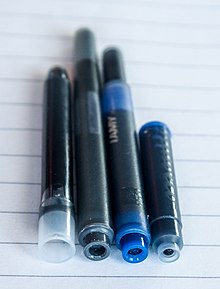
Proprietary cartridges (left to correct): Pilot, Parker, Lamy, short standard international (made past Kaweco)
Many fountain pen manufacturers have developed their ain proprietary cartridges, for example Parker, Lamy, Sheaffer, Cross, Sailor, Platinum, Platignum, Waterman, and Namiki. Fountain pens from Aurora, Hero, Duke, and Uranus have the same cartridges and converters that Parker uses and vice versa (Lamy cartridges, though not officially, are known to interchange with Parker cartridges also). Cartridges of Aurora are slightly different from cartridges by Parker.[81]
Corresponding converters to exist used instead of such proprietary cartridges are usually made past the same visitor that made the fountain pen itself. Some very compact fountain pens take only proprietary cartridges made by the same company that fabricated that pen, such as Sheaffer Agio Meaty and Sheaffer Prelude Compact. It is not possible to employ a converter in them at all. In such pens the merely practical way to use another make of ink is to fill empty cartridges with bottled ink using a syringe.[81]
Standard international cartridges are closed by a pocket-size ball, held inside the ink leave hole by mucilage or by a very thin layer of plastic. When the cartridge is pressed into the pen, a small pivot pushes in the ball, which falls inside the cartridge. The Parker and Lamy cartridges do non have such a ball. They are airtight by a piece of plastic, which is broken by a sharp pin when inserted in the pen.[78]
Concerns and alternatives [edit]
Pen manufacturers using a proprietary cartridge (which in nearly all cases are the more expensive ones like the ones mentioned above) tend to discourage the use of cheaper[82] internationally standardised short/long cartridges or adaptations thereof due to their variance in ink quality in the cartridges which may not offer as much operation, or be of lesser quality than the manufacturer of the pen; ink that has been designed specifically for the pen. In addition, cheaper ink tends to take longer to dry on newspaper, may skip or produce uneven color on the folio and exist less "tolerant" on lower, thinner grades of paper (e.one thousand. 75gs/m).[82]
While cartridges are mess-costless and more convenient to refill than bottle filling, converter and bottle filling systems are nevertheless sold. Not-cartridge filling systems tend to be slightly more than economical in the long run since ink is generally less expensive in bottles than in cartridges. Advocates of bottle-based filling systems too cite less waste of plastic for the surroundings, a wider pick of inks, easier cleaning of pens (as cartoon the ink in through the bill helps deliquesce old ink), and the power to check and refill inks at any fourth dimension.[83]
Inks [edit]
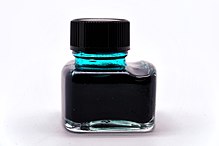
Inks intended for utilize with fountain pens are water-based. These inks are ordinarily available in bottles. Plastic cartridges came into use in the 1960s, but bottled inks are still the mainstay for virtually fountain pen enthusiasts. Bottled inks usually cost less than an equivalent amount in cartridges and afford a wider variety of colors and properties.[84]
Fountain pens are non every bit tightly coupled with their inks as ballpoints or gel pens are, notwithstanding some intendance must be taken when selecting their inks. Gimmicky fountain pen inks are almost exclusively dye-based because pigment particles usually clog the narrow passages.[84] [83]
Traditional iron gall inks intended for dip pens are not suitable for fountain pens as they will corrode the pen (a phenomenon known equally flash corrosion) and destroy the functionality of the fountain pen.[82] Instead, mod surrogate atomic number 26 gall formulas are offered for fountain pens. These modernistic atomic number 26 gall inks comprise a small amount of ferro gallic compounds, but are gentler for the within of a fountain pen, but can still exist corrosive if left in the pen for a long menses.[82] To avoid corrosion on delicate metal parts and ink clogging a more than thorough than usual cleaning regime – which requires the ink to be flushed out regularly with water – is sometimes advised by manufacturers or resellers.[85]
Some pigmented inks practice exist for fountain pens, such as "Carbon Blackness" made by the brand Platinum, but these are uncommon. Normal India ink cannot exist used in fountain pens because it contains shellac as a binder which would very quickly clog such pens.[86]
Inks ideally should be fairly free-flowing, free of sediment, and non-corrosive, though this generally excludes permanence and prevents big-scale commercial use of some colored dyes. Proper care and selection of ink will prevent well-nigh problems.[82]
Today [edit]
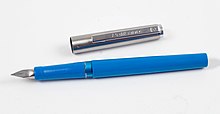
A 1970s model metallic and plastic fountain pen

The Airplane pilot Varsity, an cheap disposable fountain pen
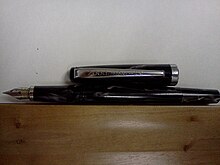
A modern celluloid fountain pen fitted with a vintage beak
While no longer the main writing instrument in modernistic times, fountain pens are notwithstanding used for of import official works such as signing valuable documents.[87] Today, fountain pens are often treated every bit luxury goods and sometimes as status symbols. Fountain pens may serve as an everyday writing instrument, much like the mutual ballpoint pen.[57] Good quality steel and golden pens are available inexpensively today, specially in Europe and Communist china, and in that location are "disposable" fountain pens such equally the Pilot Varsity. In French republic and Germany, in particular, the use of fountain pens is widespread. To avoid mistakes, special ink can be used that can be made invisible by applying an ink eraser.
Fountain pens can serve diverse creative purposes such every bit expressive penmanship and calligraphy, pen and ink artwork, and professional person art and design. Many users also favor the air of timeless elegance, personalization, and sentimentality associated with fountain pens,[88] which computers and ballpoint pens seem to lack,[89] and oftentimes state that once they get-go using fountain pens, ballpoints become awkward to utilize due to the extra motor effort needed and lack of expressiveness.
For ergonomics, fountain pens may relieve physiological stress from writing; alternatives such as the ballpoint pen tin induce more than pain and damage to those with arthritis. Some also believe they could improve bookish operation.[90] In some countries, fountain pens are usual in lower school grades, believed to teach children meliorate command over writing every bit many common mistakes of people not used to handwriting (like too much pressure or incorrect concur) feel unnatural or are almost impossible when using traditional pen tips.[91]

A modern fountain pen, writing in cursive script
Some fountain pens are treated as collectibles. Ornate pens may be made of precious metals and jewels with cloisonné designs. Some are inlaid with lacquer designs in a procedure known as maki-e.[92] Avid communities of pen enthusiasts collect and use antique and modern pens and besides collect and exchange information about quondam and modern inks, ink bottles, and inkwells. Collectors may determine to apply the antiques in addition to showcasing them in airtight spaces such as drinking glass displays.[93]
News outlets report that, rather than declining, fountain pen sales accept been steadily ascent over the last decade.[94] In that location is a clear resurgence in the appeal and civilization of the fountain pen, whether for purposes of drove, enjoyment or every bit a "lifestyle particular".[95] Many agree that the "personal touch" of a fountain pen has led to such a resurgence with modernistic consumers looking for an culling in a globe of digital products and services.[96]
Amazon reported "sales and then far this year [2012] accept doubled compared with the same period in 2011. They are iv times higher than 2010."[94] The popularity of fountain pens continues to prove growth. The market-research firm Euromonitor reported that fountain pen retail sales were up 2.1% in 2016 from a yr earlier, reaching $1.046 billion.[97]
See also [edit]
- Demonstrator pen
- Fountain pen inks
- Inkwell
- IAMPETH
- Category: Fountain pen and ink manufacturers
- List of pen types, brands and companies
- List of terms about pen and ink
Notes and references [edit]
- ^ a b c d Folder, Richard. "Filling Systems: Overview of How They Piece of work and How to Make full Them". Richard Binder'due south Pens . Retrieved 26 July 2016.
- ^ Bosworth, C. E. (1981). "A Mediaeval Islamic Paradigm of the Fountain Pen?". Journal of Semitic Studies. 26 (1): 229–234. doi:10.1093/jss/26.ii.229.
...not more than a few days passed before the craftsman, to whom the construction of this contrivance had been described, brought in the pen, fashioned from gilt. He then filled it with ink and wrote with it, and it really did write. The pen released a fiddling more ink than was necessary. Hence al-Mu'izz ordered that it should be adjusted slightly, and he did this. He brought forward the pen and behold, information technology turned out to be a pen which can be turned upside downwardly in the hand and tipped from side to side, and no trace of ink appears from it. When a secretary takes upwardly the pen and writes with information technology, he is able to write in the almost elegant script that could maybe be desired; then, when he lifts the pen off the canvas of writing material, information technology holds in the ink. I observed that it was a wonderful piece of work, the like of which I had never imagined I would ever encounter.
- ^ "La penna di Leonardo alla sala regia". Tusciaweb.eu (in Italian). September 7, 2011. Retrieved 2016-11-09 .
- ^ Schwenter, Daniel, Deliciae physico-mathematicae … (Nürnberg, (Germany): Jeremias Dümler, 1636), vol. 1, pp. 519–520 "Die III Auffgab. Ein schön Hush-hush, eine Feder zu zurichten, welche Dinten hält, und so viel lässet als human bedürfftig." (The third exercise. A prissy clandestine: to prepare a pen which holds ink and lets [flow] as much as ane requires. [with illustration])
- ^ Pepys, Samuel (Baronial 1663). Diary entries from August 1663 (Pepys' Diary). Samuel Pepys. Retrieved 27 July 2016.
- ^ a b Richardson, Hester Dorsey (1913). "Affiliate XLVII: The Fountain Pen in the Time of Charles Two". Side-lights on Maryland History, with Sketches of Early Maryland Families. Baltimore, Md.: Williams & Wilkins Co. pp. 216–17. ISBN0-8063-1468-0.
- ^ Matthew Henry, Commentary on the Whole Bible, Zechariah four. ii (1710), describing a type of self-replenishing oil lamp: "Without whatsoever farther Care they [i.e. the lamps] received Oil as fast as they wasted information technology, ('as in those which we call Fountain Inkhorns, or Fountain Pens')".
- ^ "Who Invented The Fountain Pen?". Vintage Pens . Retrieved 10 Jan 2019.
- ^ a b "Who Invented The Fountain Pen?". Best Fountain Pen. 2015-01-05. Archived from the original on 2016-x-07. Retrieved 27 July 2016.
- ^ "Perry and Co". Grace's Guide . Retrieved 27 July 2016.
- ^ "Birmingham Heritage". www.birminghamheritage.org.united kingdom of great britain and northern ireland . Retrieved 27 July 2016.
- ^ "The Manufacture of Steel Pens in Birmingham". The Illustrated London News. 18 (471). 22 February 1851.
- ^ The Times (London, England), 15 September 1885, p. 6: Obituary
- ^ "Stylographic Pens". Vintage Pens . Retrieved 27 July 2016.
- ^ Scientific American, "Fountain Pens". Munn & Company. 1878-08-x. p. 80.
- ^ Binder, Richard. "Significant Pens of the Twentieth Century". Richard Folder'southward Pens . Retrieved 27 July 2016.
- ^ a b c Folder, Richard. "Filling Organisation Histories: Here'south Mud in Your Eye(dropper)". Richard Binder's Pens . Retrieved 26 July 2016.
- ^ "Filling Instructions: Twist-Fillers". Vintage Pens . Retrieved 27 July 2016.
- ^ "Crescent Filler". His Nibs . Retrieved 27 July 2016.
- ^ a b Binder, Richard. "Filling Arrangement Histories: Lever Look Back". Richard Binder's Pens . Retrieved 26 July 2016.
- ^ Binder, Richard. "Fillers: Wring It Out!". Richard Binder'due south Pens . Retrieved 27 July 2016.
- ^ "Safety Pens". Vintage Pens.
- ^ "Center-Joint, End-Joint & 'Jointless' Eyedroppers". www.vintagepens.com . Retrieved 11 March 2017.
- ^ "Waterman Safeties". Vintage Pens.
- ^ Folder, Richard. "Design Features: Safety Pens". Richard Folder'due south Pens . Retrieved 27 July 2016.
- ^ "The Mabie Todd Swan Safe Screw Cap Eyedropper Filler". Skillful Writers' Pens. seven May 2011. Retrieved 27 July 2016.
- ^ Propas, Rick. "The PENguin – Pelikan, Parker and Other High Quality Fountain Pens". The PENguin. Archived from the original on 2016-07-26. Retrieved 27 July 2016.
- ^ "1929–1950 – The piston filling mechanism – Pelikan". Pelikan . Retrieved 26 July 2016.
- ^ Nishimura, David. "What is celluloid, and why is it not the same as cellulose nitrate/nitrocellulose?". Vintage Pens . Retrieved 26 July 2016.
- ^ "Parker Pens Penography: DUOFOLD". Parker Pens . Retrieved 27 July 2016.
- ^ Binder, Richard. "The Parker Vacumatic". Richard Binder's Pens . Retrieved 27 July 2016.
- ^ Binder, Richard. "Sheaffer's Balance". Richard Folder's Pens . Retrieved 27 July 2016.
- ^ "Dating a Pelikan". The Pelikan's Perch. 25 Baronial 2014. Retrieved 27 July 2016.
- ^ "History of the pen". Rick Conner. Archived from the original on iii May 2016. Retrieved 27 July 2016.
- ^ "Sheaffer Snorkel 1952–1959". Pen Hero . Retrieved 27 July 2016.
- ^ "J Serial Pens". Esterbrook . Retrieved 27 July 2016.
- ^ "Pens – Overview". Collectors Weekly . Retrieved 27 July 2016.
- ^ "Fountain pens boost 'self-esteem'". BBC News. November 13, 2006. Retrieved November 25, 2006.
- ^ Pidd, Helen (29 June 2011). "German language teachers entrada to simplify handwriting in schools". Guardian . Retrieved 31 July 2021.
- ^ "When Ownership Fountain Pens, Splurging (a Piddling) Is Totally Worth It". Wired. Condé Nast. September 2014. Retrieved 27 July 2016.
- ^ Brocklehurst, Steven (2012-05-22). "Why are fountain pen sales rising?". BBC News . Retrieved 2017-08-24 .
- ^ a b c "How Fountain Pens Piece of work". Explain That Stuff. 21 January 2011. Retrieved 27 July 2016.
- ^ Binder, Richard. "Feeds: Revolution, Evolution, and Devolution". Richard Binder'due south Pens . Retrieved 26 July 2016.
- ^ Gilmour, Jono (25 Baronial 2012). "Fountain Pen Guide Serial, Session 1: Nibs, Feeds, and How They Come up Together". Pentorium. Archived from the original on 2 Baronial 2016. Retrieved 26 July 2016.
- ^ "Feeds fabricated of Plastic". Fountain Pen Design. 26 July 2016. Archived from the original on 31 July 2020. Retrieved 7 November 2016.
- ^ Conner, Rick. "Construction of a fountain pen". Rick Conner. Archived from the original on 12 August 2016. Retrieved 26 July 2016.
- ^ a b Mathur, P.; Mathur, Grand.; Mathur, S. (2014-03-06). Developments and Changes in Science Based Technologies. ISBN978-1-4828-1398-2 . Retrieved 27 July 2016.
- ^ a b c d Binder, Richard. "To the Point: Nib Materials". Richard Binder'south Pens . Retrieved 26 July 2016.
- ^ "Steel vs. Gold Fountain Pen Nibs". Pen Heaven . Retrieved 26 July 2016.
- ^ "Where'south the Iridium?". The Nibster. Archived from the original on one August 2016. Retrieved 26 July 2016.
- ^ Mottishaw, J. (1999). "How can we talk about Iridium?". The PENnant. XIII (2).
- ^ a b Binder, Richard. "Nibs I: The Basics". Richard Folder'south Pens . Retrieved 26 July 2016.
- ^ Binder, Richard. "To the Point: Making Music with a Pen". Richard Binder's Pens . Retrieved 26 July 2016.
- ^ Binder, Richard. "Nibs Two: Beyond the Basics with Specialty Nibs". Richard Binder's Pens . Retrieved 26 July 2016.
- ^ "Grading Flex Nibs". VintagePen . Retrieved 26 July 2016.
- ^ Binder, Richard. "Rethinking The Value of Steel Nibs". Richard Binder's Pens . Retrieved 27 July 2016.
- ^ a b c d "Fountain Pen Guide". Gentleman'south Gazette. viii May 2015. Retrieved 27 July 2016.
- ^ Binder, Richard. "To the Point: Steal the Steel". Richard Binder's Pens . Retrieved 26 July 2016.
- ^ "How to Collect and Buy Vintage Fountain Pens". The Art of Manliness. xix November 2015. Retrieved 27 July 2016.
- ^ "Parker 61". ParkerPens.cyberspace . Retrieved 31 July 2021.
- ^ "Parker 100". ParkerPens.cyberspace . Retrieved 31 July 2021.
- ^ "Lamy 2000 Fountain Pen". Unsharpen.com . Retrieved 31 July 2021.
- ^ Binder, Richard. "To the Point: Nibz 'n the Hood". Richard Binder's Pens . Retrieved 26 July 2016.
- ^ "What is the Purpose of a Hooded Pecker?". 11 October 2017. Retrieved 27 February 2021.
- ^ Folder, Richard. "Design Features: Integral Nibs". Richard Binder's Pens . Retrieved 27 July 2016.
- ^ Binder, Richard. "Filling Organisation Histories: Capillary Pens – the Perfect Filler?". Richard Binder'south Pens . Retrieved 26 July 2016.
- ^ "Conklin Crescent Fillers". Vintage Pens . Retrieved 26 July 2016.
- ^ "Conklin – Crescent Filler Collection". Conklin Pens. Archived from the original on xv July 2016. Retrieved 26 July 2016.
- ^ "Sheaffer Snorkel 1952–1959". Pen Hero . Retrieved 26 July 2016.
- ^ "1929–1950 – The piston filling mechanism". Pelikan . Retrieved 27 July 2016.
- ^ "PenHero.com – PenGallery – Sheaffer Touchdown Filling System". Pen Hero . Retrieved 26 July 2016.
- ^ Binder, Richard. "How to Restore the Touchdown Filling System". Richard Binder's Pens . Retrieved 26 July 2016.
- ^ Match, Richard (September 1956). "Things you lot never knew about your pen". Popular Scientific discipline Monthly. New York. 169 (3): 278.
it drinks its fill automatically, by a contrary application of our old friend capillary action
- ^ Conner, Rick (2005-01-20). "Parker 61". PRick Conner. Archived from the original on 2008-10-xi. Retrieved 2008-08-08 .
- ^ a b Folder, Richard. "Design Features: What Were They Thinking?". Richard Binder'southward Pens . Retrieved 26 July 2016.
- ^ "Fountain Pen Filling Systems Explained - JetPens.com". www.jetpens.com . Retrieved 2018-05-04 .
- ^ Nishimura, David. "Early Cartridge Pens". Vintage Pens . Retrieved 20 May 2014. [ permanent dead link ]
- ^ a b Goulet, Brian (30 June 2016). "Who Invented Standard International Cartridges? – Q&A Slices". YouTube (Goulet Pens). Goulet Pens. Archived from the original on 2021-12-eleven. Retrieved 27 July 2016.
- ^ "Fountain Pen Converters". Nibs . Retrieved 27 July 2016.
- ^ "Which Ink Cartridges Can Exist Used With Which Fountain Pens?". Nibs . Retrieved 27 July 2016.
- ^ a b "Fountain Pen Ink Cartridges". Nibs . Retrieved 27 July 2016.
- ^ a b c d e Folder, Richard. "Inks: The Practiced, the Bad, and the Ugly". Richard Binder's Pens . Retrieved 26 July 2016.
- ^ a b "Cartridge vs. converter". Goldspot Pens. 2010. Retrieved 2016-07-27 .
- ^ a b "Fountain pen inks aren't all the same". Penfountain. 2010. Retrieved 2011-02-xx .
- ^ "Pen maintenance". Nibs . Retrieved 2016-07-27 .
- ^ Covington, Michael A. "A Few Notes Nearly Fountain Pens". A Few Notes About Fountain Pens . Retrieved 2011-02-twenty .
- ^ "Seal the Deal: The Mightest Fountain Pens". Forbes. 17 June 2015.
- ^ Yoko Hani (24 December 2006). "Find out why a fountain pen 'personalizes' your prose". Nippon Times.
the key give-and-take I was left with was 'personal' – non simply because a fountain pen will over time alter to accommodate your writing style, but considering – unlike a typewriter or a keyboard – it volition reflect your moods and feelings in the actual class of your writing
- ^ Yoko Hani (24 December 2006). "Find out why a fountain pen 'personalizes' your prose". Nippon Times.
the unique feature of fountain pens that differentiates them from workaday ballpoints – permit alone pencils. Also, ballpoints are in their all-time condition when they are brand new, whereas fountain pens go better the more than you utilise them, Toshifumi Iijima, another of the museum's staff explained.
- ^ Mcginty, Stephen (November thirteen, 2006). "Schoolhouse brings back pens so pupils get write stuff". Edinburgh: news.scotsman.com. Retrieved December 11, 2006.
The school believes that mastering stylish handwriting with a fountain pen raises academic performance and boosts self-esteem.
- ^ "Goulet Pens Blog: The seven Biggest Fountain Pen Mistakes". weblog.gouletpens.com. 2016-02-23. Archived from the original on 2017-10-01. Retrieved 26 July 2016.
- ^ "Penna Magazine – Namiki Maki-e Guide". Pen Magazine. Archived from the original on 30 October 2020. Retrieved 26 July 2016.
- ^ Morrison, Lennox. "The fascination with fountain pens". BBC . Retrieved 27 July 2016.
- ^ a b Brocklehurst, Steven (22 May 2012). "Why are fountain pen sales rising?". BBC News Magazine . Retrieved 26 July 2016.
- ^ Canham, Jacqui (twenty July 2007). "Write way to earn a turn a profit: Fountain pens are gaining popularity every bit". The Independent . Retrieved 26 July 2016.
- ^ Hall, James (23 May 2012). "Fountain pen sales double". The Telegraph. Archived from the original on 2022-01-12. Retrieved 26 July 2016.
- ^ Patterson, Troy (half dozen February 2017). "Fountain pen sales are surging, despite flat luxury global sales". Chicago Tribune . Retrieved 4 May 2018.
Bibliography [edit]
- Finlay, Michael (1990). Western Writing Implements in the Historic period of the Quill Pen. Wheteral: Plains Books. ISBN1-872477-00-3.
- Fischler, George; Schneider, Stuart (1992). Fountain Pens and Pencils. New York: Shiffer Publishing. ISBN0-88740-346-8.
- Lambrou, Andreas (2003). Fountain Pens of the World. New York: Philip Wilson Publisher. ISBN0-302-00668-0.
- Park, JongJin (2013). Fountain Pens. Seoul: LBIG Media Publishing. ISBN978-89-94819-09-nine.
Farther reading [edit]
- Lambrou, Andreas (2005). Fountain Pens of the World. ISBN978-0-85667-615-4.
- Erano, Paul (2004). Fountain Pens Past and Nowadays. ISBN978-one-57432-385-6.
External links [edit]
- Reddit Fountain Pens
- Branded Fountain Pens Collection
- The Fountain Pen Network

Mass Of An Ink Pen,
Source: https://en.wikipedia.org/wiki/Fountain_pen
Posted by: knowleswerefurser56.blogspot.com
0 Response to "Mass Of An Ink Pen"
Post a Comment