

How Do You Configure Ip Camera?
Virtually users of IP cameras (network security cameras) want to admission their camera remotely to run into alive video. Accessing cameras remotely from desktop software (Mac and Windows) and mobile apps (iPhone and Android) is extremely mutual for dwelling house owners and business owners.
The well-nigh common way to enable remote viewing to IP cameras is by manually setting up port forwarding on the network router that the camera is continued to. UPnP (universal plug-and-play) is a newer method that is supported by some routers and cameras merely is not as reliable in my experience. This commodity explains ports forwarding and dynamic DNS – 2 concepts to empathise if you lot want to admission security cameras remotely. Setting up port forwarding for multiple IP cameras is also covered.
Please note that although this article focuses on IP cameras, the procedure and concepts are the same for network video recorders and security photographic camera DVRs.
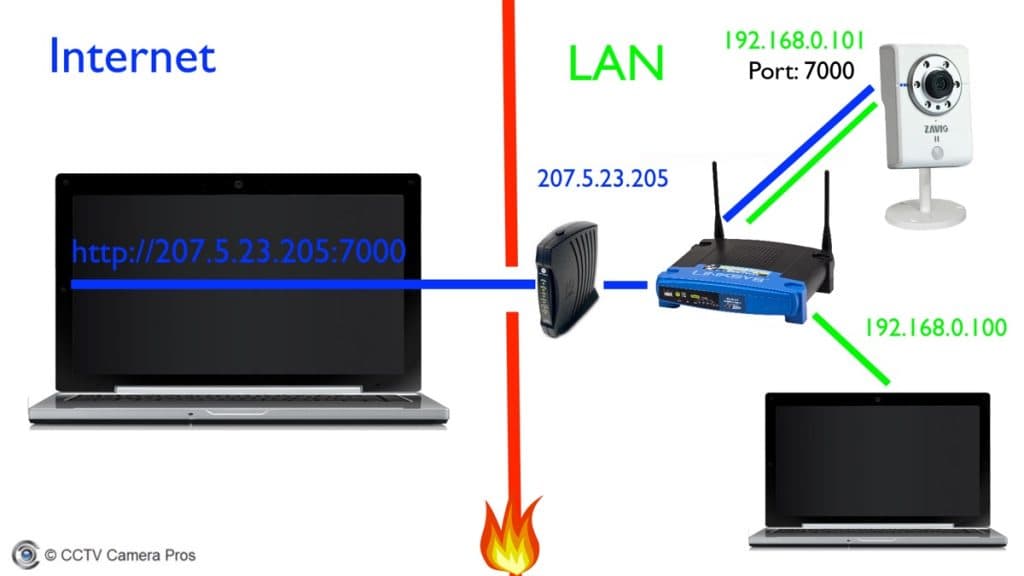
Here is and caption of how it works using the above network diagram to explicate.
Network Diagram / Wiring Installation Explanation
- All of the devices on the correct of the red line are on the local network where the photographic camera is located.
- The laptop on the left of the ruddy firewall is at a unlike location than the IP camera and not connected to the same network. The laptop on the left can be located anywhere in the globe every bit long as it is connected to the Internet.
- The ruby line in the heart represents the firewall that separates the local network from Internet.
- The IP camera in the upper right is hard wired to a network router using CAT5 Ethernet cable.
- The laptop on the right is also difficult wired to the same router.
- The network router is difficult wired to the Internet modem using CAT5 Ethernet cable. This modem tin can be a cable, DSL, straight fiber, or any other type of high speed Internet modem.
Connect to Photographic camera on LAN
Earlier you setup port forwarding for remote access, you should first connect to your cameras on the LAN (local area network).
- Our IP camera is running on port 7000. Delight notation that different IP camera manufacturers employ different default ports. Check your manual to confirm the port that your camera uses. Please notation that you tin can modify your camera's port when you lot login to it.
- Typically, when you connect an IP photographic camera to a router and power it on, the camera is assigned an IP address by the router. This is known equally DHCP (Dynamic Host Configuration Protocol). Our IP photographic camera was assigned IP address 192.168.0.101. Most IP camera manufacturers have their cameras setup to apply DHCP by default, but some take a static IP address assigned to their cameras. You need to cheque your camera's manual to ostend. If you are unsure, plug your camera into your router and power it on. Most IP cameras include PC software to search your network for IP cameras. If yours does, run this software to locate the IP accost of your camera and make notation of it.
- Using a computer on the aforementioned network every bit your IP camera, login to your IP camera. IN our example, we are using a laptop on the local network with IP address 192.168.0.2. Most IP cameras have an interface that can be accessed via spider web browser. In our case, would enter the following address into the web browser of the laptop on the right. https://192.168.0.101:7000. If the accost and port is correct, you will well-nigh likely be prompt for a user ID and countersign by your camera.
- Enter the default ID and password and you should see a live view of your camera or a configuration screen. Congratulations, you just accessed your camera on the LAN.
IP Reservation
After confirming that you can access the IP camera on the LAN (local expanse network), you should reserve that IP address specifically for your IP camera. By reserving an IP for your camera, if your router looses ability or needs to exist re-booted, that same IP will e'er be assigned. This is important because your port forwarding rule that you lot volition setup volition not piece of work if the IP address of the camera changes. Consult with your router's manual on how to setup IP reservations for your specific model.
Port Forwarding Setup / Network Setup
Port forwarding is what enables you to access your camera remotely over the Internet. In the above diagram, the red line represents the firewall provided by the router. Basically, no outside traffic is immune into your network. When you lot setup a port forwarding rule, y'all create a controlled hole in your firewall.
To ready port forwarding, login to your router and navigate to the port forwarding section of the interface. This volition vary past make and model. You should consult your manual or search online for instructions.
In our instance, we frontward incoming requests on port 7000 to IP address 192.168.0.101 on port 7000. This allows admission to your network, through your network firewall, (only on port 7000) and forward all of those requests to your IP camera.
Exam Remote Access
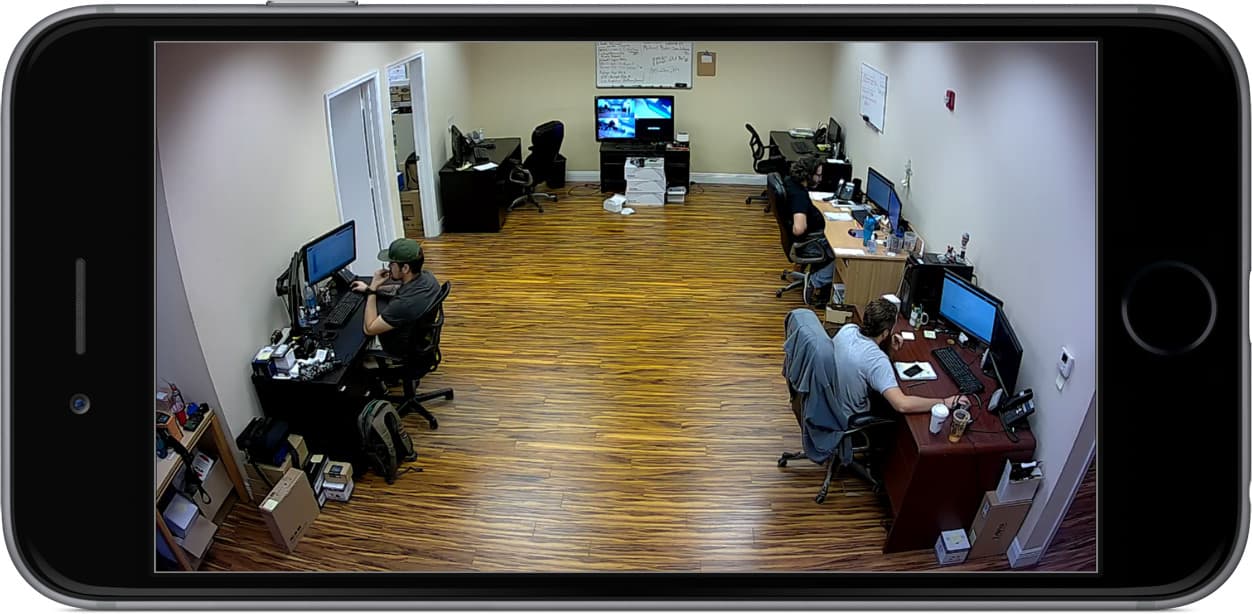
To confirm that port forwarding is setup properly, yous must try to connect from a device that is not on the same network as your camera. If yous are on-site where the camera is located, you can turn off the WIFI connection of your phone and so that you connect over the cellular phone network.
- 207.5.23.205 is the IP address of the Internet connection in the above example. You can find out what your Internet IP address is past using accessing this page from whatever figurer or mobile device on the network where your photographic camera is located: What is my IP Address?
- If you have trouble accessing your camera, usa this open port forwarding test tool to see if the port is properly open.
DDNS Setup for Dynamic IP Addresses
Contact your Internet access provider and ask them if your Internet connection has a static or dynamic IP address. If yous are fortunate enough to take a static IP accost, yous can ever access your camera remotely using the IP accost of the Internet connection (207.five.23.205 in our instance) where your camera is installed. If your Internet IP address is dynamic, yous should setup a DDNS service to manage changes in your IP accost.
DDNS Account Setup
- Create an account with a DDNS service provider. DynDNS and No-IP are 2 of the biggest service providers out there. At the time of this writing, DynDNS cost $40 per year and No-IP has a free account that requires that you lot login through a web browser one time a calendar month to proceed it active. Some IP photographic camera manufacturers provide their own DDNS service for free.
- After you setup an account with the DDNS provider of your selection, a connection to the service must be made from your IP camera, a PC on the same network, or in your router. Where you do this depends on which of your devices support the DDNS update service.
- When you lot setup your account, yous volition choose a hostname to use. For case, my-ip-camera.ddns.org. Subsequently DDNS is setup, you lot will use this hostname instead of your IP address to admission your IP photographic camera remotely.
- You can see these instructions on how to setup DDNS for Zavio IP cameras. Please note that not all IP cameras accept this built-in. If yours does not, check to see if your router supports it or your terminal selection is to install a DDNS client on a PC. Please note that if you choose the PC choice, that PC must always exist running.
How DDNS works
Here is how DDNS service works.
- There is a service running on your IP photographic camera (or network router or PC if you chose those options) that monitors the IP address of your Net connection.
- When the service detects a modify, it contacts the DDNS provider and updates them with the new IP address.
- The DDNS provider updates the record for your hostname with the new IP address.
The result is that whenever you access your camera remotely using the DDNS hostname (my-ip-camera.ddns.org is my case), the request is always routed to the right IP accost.
Port Forwarding Multiple IP Cameras
Suppose you lot want to enable remote access for more than 1 IP camera. The IP cameras are the same brand, maybe fifty-fifty the same model – then they use the aforementioned port. This is how you can setup port forwarding for multiple IP cameras running on the same port.
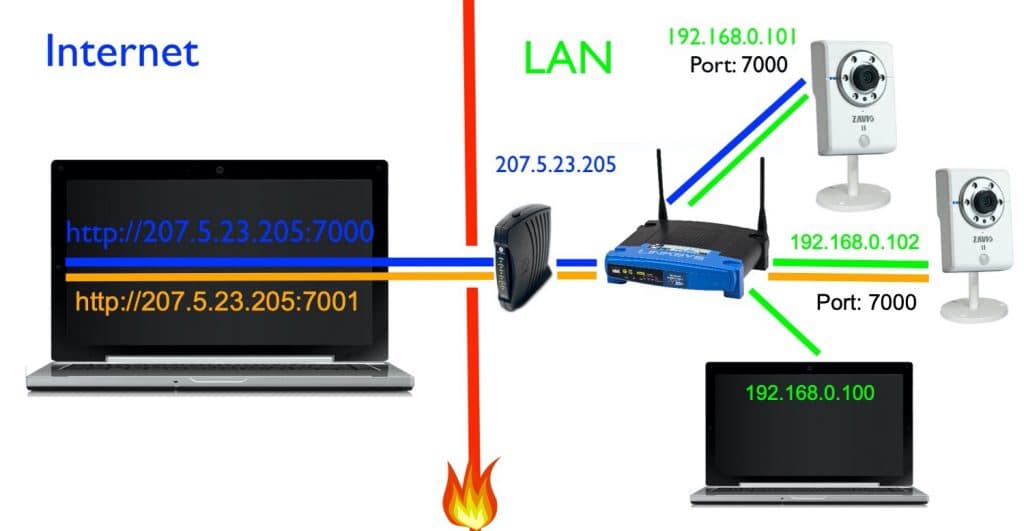
Hither is the aforementioned diagram that was used in the first explanation except a second IP camera was added to the network. Everything is setup the same way with the following additions and notes.
- The 2nd IP camera is assigned LAN IP accost 192.168.0.102.
- The 2d IP photographic camera uses the same port as the first one, 7000.
- The port forwarding on the router is configured to forwards port 7001 to the second IP camera at address 192.168.0.102 on port 7000.
You see that the external Internet port does not need to match the internal LAN port that y'all setup forwarding to on your router.
Alternatively, y'all could modify the port that the second IP photographic camera uses in the IP photographic camera's settings. For example, you could switch the second IP camera to utilize port 7001 instead of 7000. I have personally institute that it is easier to manage if you keep all of you IP cameras on their default ports and setup unique forwarding ports, equally described in the above digram.
What is Port Forwarding?
If you would similar farther caption of port forwarding, please watch this video.

Source: https://videos.cctvcamerapros.com/surveillance-systems/port-forwarding-remote-access-setup-for-ip-security-cameras.html
Posted by: knowleswerefurser56.blogspot.com
0 Response to "How Do You Configure Ip Camera?"
Post a Comment